Guide for parents
How kids learn Chinese with pinyin and pictures

Can a child learn Chinese with pinyin? Yes, and for a beginner it is the easiest way in. Pinyin writes the sounds of Mandarin in the Roman letters your child may already know, with small marks above the vowels for the tones. A child who sees 猫 with māo above it and a picture of a cat can say the word on the first try. Over time, the pinyin becomes a support they look at less, and the character becomes the thing they read.
This guide explains what pinyin shows, how to read the tone marks, how to move from pinyin to characters, and how a parent who does not speak Chinese can still help.
What pinyin is, and what it is not
Pinyin (in full, Hanyu Pinyin) is the standard system for spelling Mandarin sounds with Roman letters. It is taught in schools in mainland China and widely used in courses for learners elsewhere. Every Chinese character has a pinyin spelling: 狗 is gǒu, dog; 书 is shū, book.
Pinyin is a guide to sound. Many different characters share the same pinyin, so a reader still needs the characters in the end. For a young beginner that does not matter much. What matters is that pinyin lets them say a new word without waiting for an adult, which is the same independence a child gets from sounding out an English word.
Research with learners of Chinese as a foreign language supports this. In a 2020 study of 158 Indonesian primary students, Xiao, Xu and Rusamy found that students' pinyin spelling skills were linked to their reading comprehension, through their listening and vocabulary knowledge, even after taking their character writing into account.
Reading pinyin tone marks with kids
Mandarin uses tones: the pitch of a syllable changes its meaning. Pinyin shows the tone with a mark over a vowel. There are four marked tones and one light, unmarked tone.
| Tone | Mark | How it sounds | Example |
|---|---|---|---|
| First | ā | High and level, like a held note | 猫 māo (cat) |
| Second | á | Rising, like asking "what?" | 球 qiú (ball) |
| Third | ǎ | Low, dipping down | 狗 gǒu (dog) |
| Fourth | à | Sharp and falling, like "no!" | 画 huà (picture) |
| Neutral | none | Short and light | the zi in 兔子 tù zi (rabbit) |
Children often find tones easier than adults expect, especially if they hear each word many times from a clear model. Use your hand to draw the tone in the air while you say the word: flat, up, down and up, down.
Beginner Chinese words for kids, with pinyin
Start with things your child can see. The words below come from the beginner levels in Wordventure's pet shop, zoo, supermarket and kitchen scenes.
| Character | Pinyin | English | Place |
|---|---|---|---|
| 猫 | māo | cat | Pet shop |
| 狗 | gǒu | dog | Pet shop |
| 兔子 | tù zi | rabbit | Pet shop |
| 大象 | dà xiàng | elephant | Zoo |
| 长颈鹿 | cháng jǐng lù | giraffe | Zoo |
| 熊猫 | xióng māo | panda | Zoo |
| 苹果 | píng guǒ | apple | Supermarket |
| 面包 | miàn bāo | bread | Supermarket |
| 牛奶 | niú nǎi | milk | Supermarket |
| 冰箱 | bīng xiāng | fridge | Kitchen |
| 碗 | wǎn | bowl | Kitchen |
| 桌子 | zhuō zi | table | Kitchen |
Look for patterns with your child. 熊猫, panda, ends with 猫, the word for cat: it is a "bear cat." Small discoveries like this make characters feel less like random shapes.
From pinyin to characters: a simple order for beginners
- Picture and sound first. Your child taps or points to a picture and hears the word. No reading yet.
- Add pinyin. Show the pinyin while they hear the word, so they connect the letters and tone marks with the sound.
- Add the character beside it. The character, pinyin and picture appear together. Your child is not expected to remember the character yet.
- Read the character alone. Show only the character and ask your child to find the matching picture. When they can do this, they are reading the word.
The last step is the one children skip if pinyin is always there. Make room for it with games that show the character on its own.
Chinese mode and Find it in Wordventure
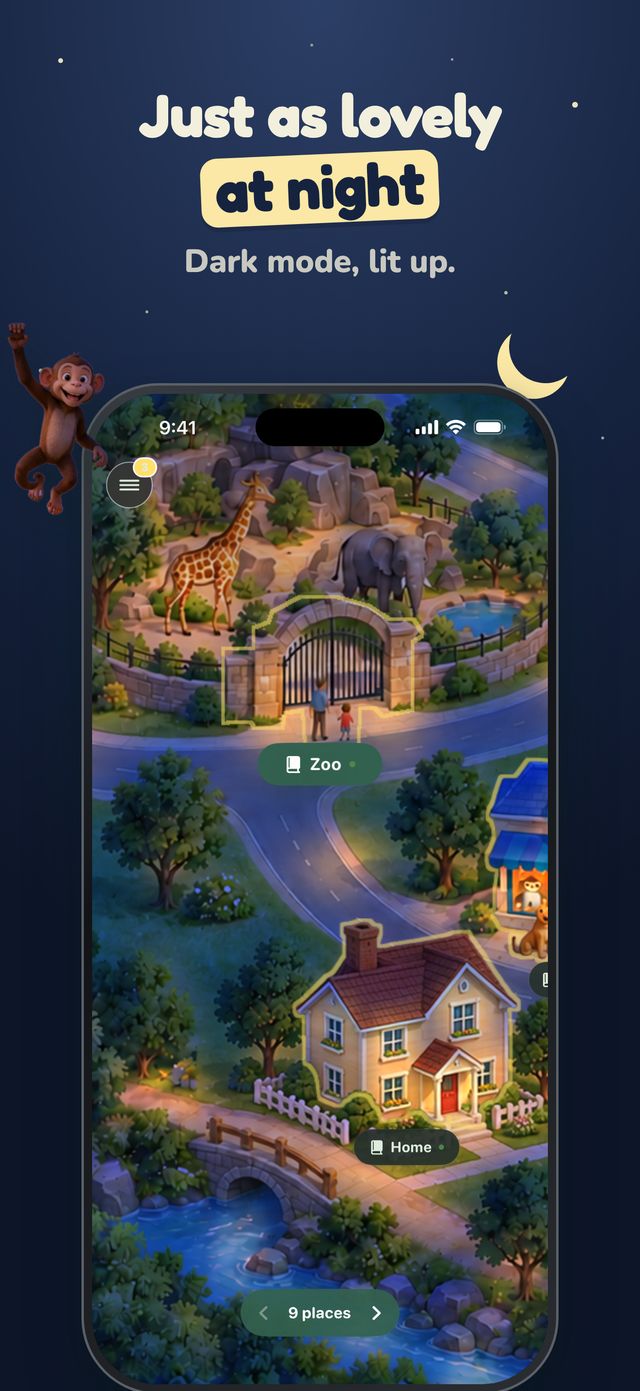
Wordventure's Chinese mode supports each of these steps. Your child taps an object in a scene and it lifts out of the picture with its Chinese word, its pinyin and its meaning, and the word is spoken aloud. Meanings can be shown in English, so a parent who does not speak Chinese can follow along.
For the final step there is Find it: the app shows a character, and your child taps the matching object in the scene. That is reading, with the picture as the check. Every word in the nine places has a Chinese name and pinyin, from the zoo to the three rooms at home, and words your child misses can be saved as flashcards that return on a spaced schedule.
A ten-minute Chinese session for kids
Short sessions on most days work better than one long lesson a week. Here is a simple plan that uses one place and six words:
- Minutes 1 to 3: listen and point. Say or play each word and let your child point to the picture. Draw the tone in the air as you go.
- Minutes 4 to 6: say it. Point to each picture and ask your child to say the word. Give the first sound as a hint if they get stuck.
- Minutes 7 to 9: read it. Show two or three of the characters alone and ask your child to find the matching picture.
- Minute 10: pick tomorrow's words. Any word your child could not say or find goes first in the next session.
Stay with the same six words for three or four days before adding more. Children often recognize a character by sight well before they can say it without help, so count finding it as progress.
If you do not speak Chinese yourself
You can still help a lot. Learn the words with your child, using the app's audio as the model for both of you. Ask your child to teach you the tones; children enjoy correcting a parent. Keep sessions short, ten minutes on most days, and repeat the same place for a week before moving on.
If your family speaks another language at home, your child may mix words from Chinese, English and your home language for a while. Mixing is an expected part of learning more than one language. The guide to teaching English at home covers how to use a home language alongside a new one.
Questions parents ask
Should my child learn pinyin or Chinese characters first?
For a young beginner, pinyin and pictures first makes it possible to say new words without help. Add characters beside the pinyin early, then practice reading characters on their own so pinyin does not become a permanent crutch.
Can I help my child learn Chinese if I do not speak it?
Yes. Use recorded audio as the model, learn the words alongside your child, and ask them to teach you the tones. Short daily sessions with the same small set of words help more than your own pronunciation does.