Guide for parents
Picture vocabulary activities for home and the classroom

The picture vocabulary activities that work best are short games where a child has to find, name or match something in a picture: I Spy in a busy scene, Kim's game with a tray of objects, memory cards, and sorting pictures by where you would see them. Each takes five to ten minutes and needs little more than a picture book, some cards or the room you are sitting in.
Below are eight activities, roughly in order from easiest to hardest, with notes on what each one practices. They work for a parent with one child at the kitchen table and for a teacher with a small group.
Why pictures help children learn new words
A young child learning a word has two jobs: connect a sound to a thing, and then find that sound again later without help. Pictures help with both. They give the child something to point at, so you do not need a translation or a definition, and a busy scene gives each word neighbors. A child who remembers the zebra is near the lion has two ways back to the word.
Cambridge English builds its first word list for young learners the same way. The Pre A1 Starters wordlist picture book groups words into large scenes such as At the zoo, At home and At school, with questions to talk about under each picture. The activities below follow that idea: start from a scene, then pull words out of it.
Picture vocabulary games that need no preparation
These three work with any picture book, poster or room.
1. Point to it
You say a word, your child points to it in the picture. This is the easiest game because the child only has to recognize the word, not produce it. Use it for the first meeting with a new scene, and keep going until they find each thing quickly.
2. I Spy in a scene
Pick something in the picture and give a clue: "I spy something yellow with a long neck." For children who are just starting English, use color and size clues; for stronger speakers, use what the thing does ("I spy something you use to brush your teeth"). Then swap roles so your child gives the clues.
3. What is missing?
Look at a picture together for fifteen seconds, then cover it. Ask your child to name as many things as they can remember. Uncover it and check together. Children remember more each time, which they enjoy seeing.
Picture card games for vocabulary
The British Council's LearnEnglish Kids advice for parents lists flashcard games such as Memory, Kim's game and Snap as good ways to practice words at home. A pack of twelve homemade cards, each with a picture on the front, is enough for all of them.
4. Kim's game
Put six real objects or picture cards on a tray: a spoon, a cup, an apple, a ball. Your child looks for thirty seconds and closes their eyes while you take one away. They open their eyes and name the missing thing. Add one more object each round.
5. Memory with pictures and words
Make pairs: one card with a picture, one with the written word. Lay them face down and take turns turning over two. A child who cannot read yet can play with picture pairs and say the word aloud each time they turn one over.
6. Sort by place
Shuffle cards from different places and ask your child to sort them: what lives at the zoo, what you buy at the supermarket, what is in the bathroom. Sorting asks a child to think about meaning, which helps the word last. The first words list grouped by place gives you 100 words already sorted this way.
Harder picture activities for confident learners
7. Draw and label
Give your child a blank sheet and a place: "Draw our kitchen." When the drawing is done, they label what they can, and you help with the rest. The labels do not need to be spelled correctly at first. Saying each word while they write it is the useful part.
8. Spell the picture
Point to a thing in a scene and ask your child to spell it out loud or on paper. Start with short words like cat, bag and cup, and keep longer words for later. If they get stuck, say the word slowly and let them try again before showing the spelling.
Picture vocabulary practice in an app
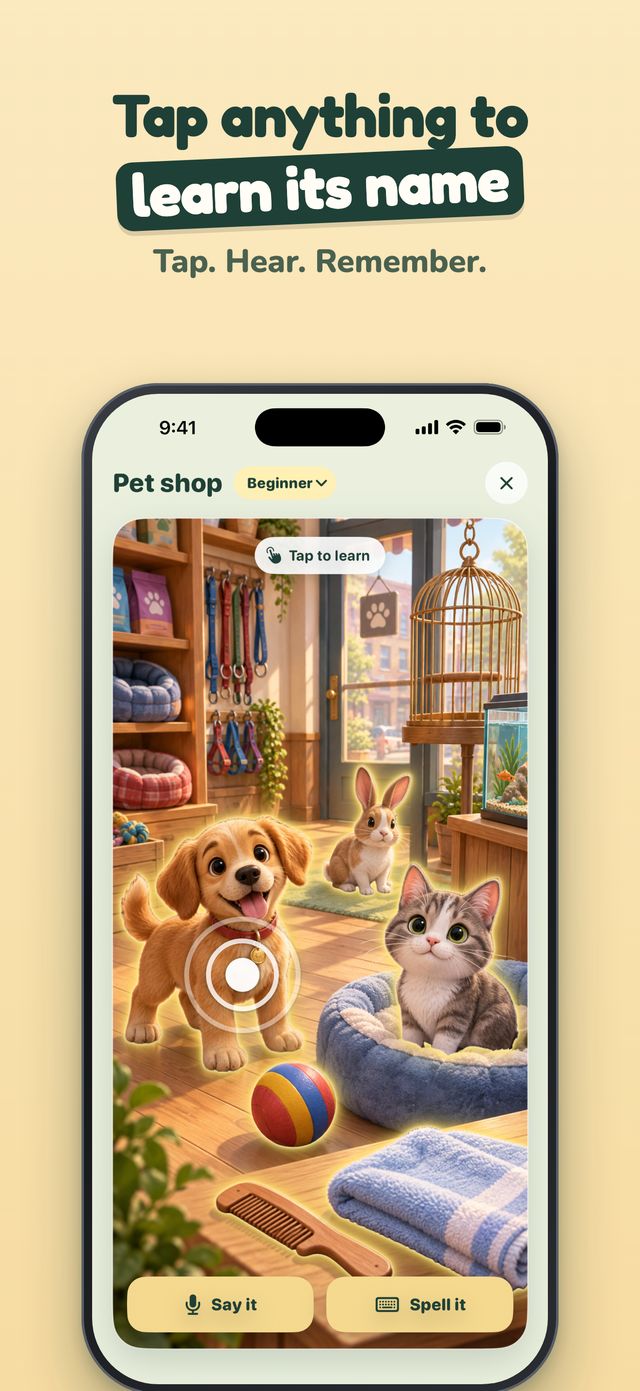
Wordventure turns the first and last activities into an app. Each of the nine places on the town map is a hand-painted scene, and your child taps anything in it to hear what it is called. The object lifts out of the picture with its word, how to say it, and its meaning in English, Chinese, French, German or Spanish.
After tapping around, a child can try Say it, where they answer out loud and the app listens and checks, or Spell it, where they hear a word and type it letter by letter with no timer. In Chinese mode there is also Find it: the child reads a character and taps the matching object in the scene, which is the same game as Point to it, played with written words. Words a child misses can be kept as flashcards that come back on a schedule, which the spaced repetition guide explains.
Putting the activities into a week
One scene a week is a good pace for children aged four to seven. Use the easy games early in the week and the harder ones once the words are familiar.
| Day | Activity | Time |
|---|---|---|
| Monday | Point to it, then I Spy | 5 min |
| Tuesday | What is missing? | 5 min |
| Wednesday | Kim's game with real objects | 10 min |
| Thursday | Memory with picture and word cards | 10 min |
| Friday | Draw and label, or spell the picture | 10 min |
If your child loses interest, stop and come back the next day. Short sessions repeated over several days do more than one long one.
In a classroom, the same plan works with small groups. Project one large scene for the whole class on Monday, then give each group of four a set of picture cards for the card games later in the week. Let children take turns being the one who gives clues in I Spy, since producing a clue is harder practice than finding the answer. For a class with mixed levels, give stronger children the harder jobs: describing a thing without saying its name, or spelling it on the board.
Questions parents ask
Do picture vocabulary games work for children who cannot read yet?
Yes. Point to it, I Spy, What is missing and Kim's game all work with spoken words only. Add written labels later, once your child knows the words by sound.
How long should a picture vocabulary game last?
Five to ten minutes is enough for most children aged four to seven. Stop while your child is still enjoying it, and come back to the same picture the next day.