Guide for parents
How to help a child pronounce English words when English is a new language

A child learning English gets better at pronouncing words by hearing a clear model many times, saying the word out loud soon after, and getting a quick, kind signal about whether it came across. Short practice on most days does more than long correction sessions. Praise the attempt, repeat the word correctly in your reply, and move on.
This guide is about children learning English as a new language. It is not about speech therapy. An accent is not a speech problem, but if you are worried about how your child speaks in any language, the right person to ask is a speech-language pathologist. There is more on that at the end.
Accent or speech problem? Know the difference first
The American Speech-Language-Hearing Association (ASHA) states that accents, whether regional, foreign or nonnative, are not a communication disorder, and that everyone has an accent. A child who says sink for think because their first language has no th sound is learning English normally.
Aim for clear speech that other people can understand easily. That goal takes pressure off both of you. A child who is corrected on every sound soon stops trying; a child who is understood keeps talking, and talking is how pronunciation improves.
Hear it first: listening comes before speaking
Children usually need to hear a word many times before they are ready to say it. The British Council's LearnEnglish Kids team makes this point for parents teaching English at home, and also suggests songs, which help with both vocabulary and pronunciation.
Give your child a clear model. If your own English pronunciation is uncertain, use recorded audio: an audiobook, a song, or an app that speaks each word. Listen together, and ask your child to point to the thing when they hear its name before you ask them to say it.
English pronunciation practice for kids at home
Once a word is familiar by ear, practice saying it. These habits work for children aged four and up:
- Say it back, do not correct. If your child says "elefant," answer "Yes, an elephant!" with the right sound. They hear the model again without being told they were wrong.
- Slow, then normal. Say a long word slowly in parts (el-e-phant), then at normal speed, and let your child copy both.
- Clap the syllables. Clapping pine-ap-ple or gi-raffe helps children hear where the stress falls, which matters as much as single sounds.
- Watch the mouth. For sounds like th, show your tongue between your teeth and let your child try it in a mirror.
- Keep it short. Five minutes on five words is plenty. Use the same words again the next day.
English sounds that children learning English often find hard
Which sounds are hard depends on your child's first language. A few patterns come up often:
| First language | Often hard in English | Practice words |
|---|---|---|
| Mandarin Chinese | Sounds at the end of words, and the th sounds | milk, bread, bath, cat |
| Spanish | Words starting with s plus another consonant; short vowels | school, swing, ship, sheep |
| French | The h at the start of words, and the th sounds | hospital, horse, three, this |
| German | The th sounds, and w versus v | three, window, van, toothbrush |
Treat this as a starting point. Listen to your own child and pick the two or three sounds that make them hardest to understand.
Pronunciation games for kids learning English
Children practice longer when it feels like play. These games use the same few words and take five minutes each.
Robot talk
Say a word like a slow robot, one syllable at a time: ba-na-na, el-e-phant. Your child answers in robot voice, then says it again as a person. Splitting the word helps children hear each part, and switching back to normal speed practices the stress.
Whisper, normal, loud
Say a word in a whisper, your child copies; then in a normal voice; then loudly. Children enjoy the change in volume, and saying the same word three times in a row gives them three chances to get the sounds right without anyone pointing out a mistake.
Pairs that sound close
Pick two words that differ by one sound, such as ship and sheep or three and tree. Say one, and your child points to the matching picture. Then swap: your child says one and you point. If you point to the wrong one, the word was not clear, which is useful feedback that does not feel like a correction.
Using speech recognition to practice saying words out loud
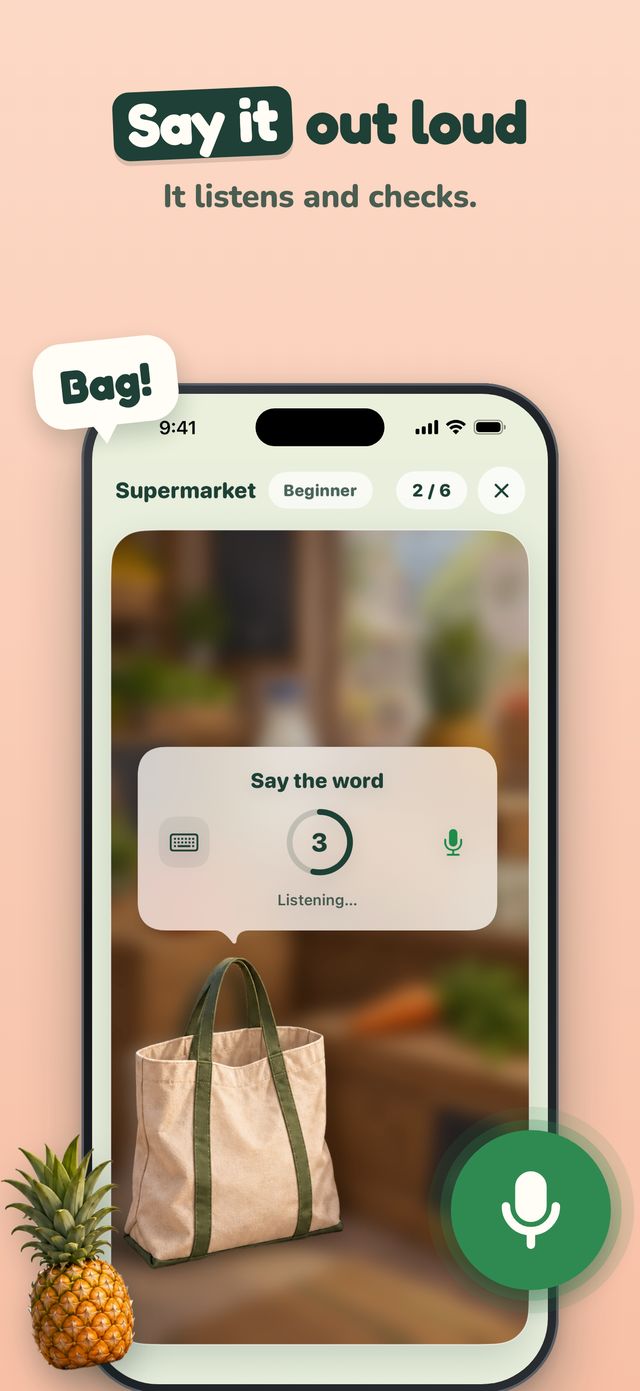
Practicing alone is hard because a child cannot easily hear their own mistakes. Speech recognition gives them a signal. In Wordventure's Say it mode, your child sees an object in a scene, such as a bag in the supermarket, and answers out loud. The app uses Apple's speech recognition to check whether it heard the right word. Any attempt that matches inside the answer window counts, so a child can try again straight away if the first try is not recognized.
Be clear about what this does. Say it checks whether the word was recognized; it does not grade an accent or teach how to make a sound. It is a practice partner, and you are still the coach. If the microphone is not an option, your child can answer with the keyboard instead. Depending on the device, Say it may need an internet connection; tapping, listening and spelling work offline. The how it works section on the homepage shows each mode.
When to talk to a speech-language pathologist
Some signs are not about learning English. Talk to your child's doctor or a speech-language pathologist if your child is hard to understand in their first language too, if they seem to struggle to hear, or if you have any other concern about their speech or language. ASHA's partner site for families advises that a speech-language pathologist can help you work out whether your child needs speech and language support.
For most children learning English, though, pronunciation grows the same way vocabulary does: with many short, friendly repetitions. The guide to teaching English at home has a daily routine to build it into, and the first words list gives you 100 words to practice.
Questions parents ask
Is my child's accent in English a problem?
No. Accents are a normal part of speaking a second language and are not a speech disorder. Aim for speech that other people understand easily, and focus practice on the few sounds that get in the way of that.
Should I correct every pronunciation mistake my child makes?
No. Repeat the word correctly in your reply instead, for example "Yes, an elephant!" Constant correction makes many children stop talking, and talking is how pronunciation improves.